ABOUT THE GROUP
Our group works on a wide range of problems related to computer architecture and systems. Most of our work is motivated by immersive computing or extended reality (XR) systems, including virtual, augmented, and mixed reality. Immersive computing, assisted by AI, has the potential to transform virtually all industries and human activities. However, there are orders of magnitude gaps in performance, power consumption, and quality of experience between current and desired immersive systems.
Our group takes a full system approach to addressing the grand challenge of enabling systems that provide comfortable, mobile, all day, rich immersive experiences. Our work includes hardware architecture, runtime systems, distributed systems (including edge and cloud offloading and orchestration), networks, data center architectures and inference serving, graphics, computer vision, and machine learning. Although our work is motivated by future immersive systems, it is in the context of broad technology challenges and often applicable to a wide range of workloads.
We build hardware and software systems, including the widely used ILLIXR (Illinois Extended Reality) testbed, the first open source end-to-end XR system. Mozart is a novel hardware architecture that enables flexible accelerator composition through software.
We are part of the IMMERSE Center for Immersive Computing, a campus-wide center, directed by Professor Sarita Adve, that brings together expertise in immersive technologies, applications, and human experience, providing unique opportunities for broad collaborations towards impactful research.
ILLIXR (Illinois Extended Reality)
Scalable Specialization
IMMERSE

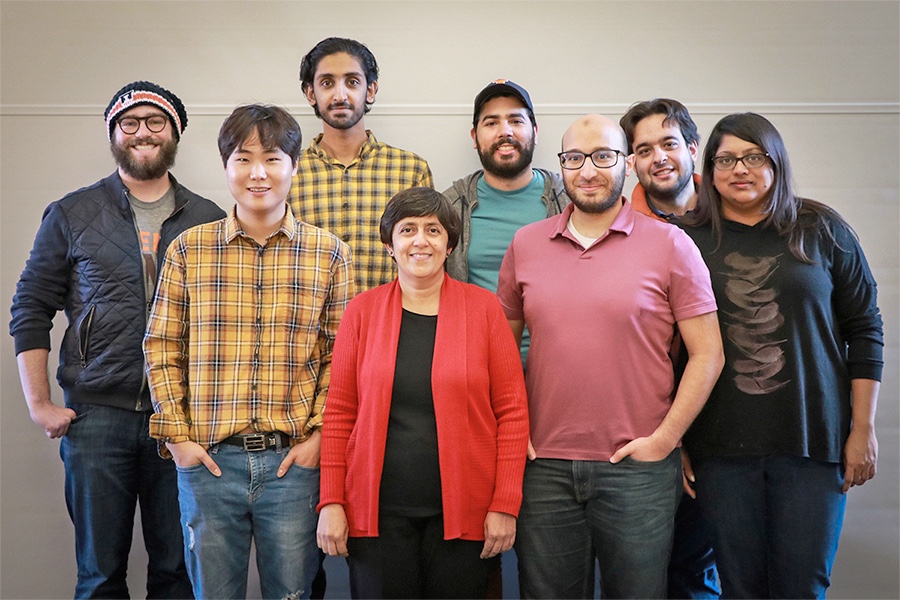
The group at the 2025 IMMERSE Symposium (left to right): Vignesh Suresh, Bill Sherman, Sriram Devata, Bakshree Mishra, Qinjun Jiang, Sarita Adve, Ying Jing, Boyuan Tian, Yihan Pang, Rahul Singh
We are very proud that for three of the last five years (2014-18), a PhD thesis from our group has been selected as one of the Illinois CS department's two nominations for the ACM doctoral dissertation award.
Matt Sinclair for 2018 :
Efficient Coherence and Consistency for Specialized Memory Hierarchies
Hyojin Sung for 2016 :
DeNovo: Rethinking the Memory Hierarchy for Disciplined Parallelism
Siva Sastry Hari for 2014 :
Preserving Application Reliability on Unreliable Hardware
OTHER PAST IMPACT
-
Memory consistency models: Co-developed the memory models for the C++ and Java programming languages, based on our early work on data-race-free models
-
Hardware reliability: co-developed the concept of lifetime reliability aware architectures and dynamic reliability management, pioneered techniques for ultra-low cost software-driven hardware resiliency
-
Power management: Co-designed GRACE, one of the first systems to implement cross-layer energy management
-
Memory level parallelism: Some of the first papers on exploiting instruction-level parallelism (ILP) for memory system performance
-
Evaluation techniques: Developed RSIM, the first publicly available multiprocessor simulator with out-of-order processors
|